

Event Table Rentals: Everything You Need to Know
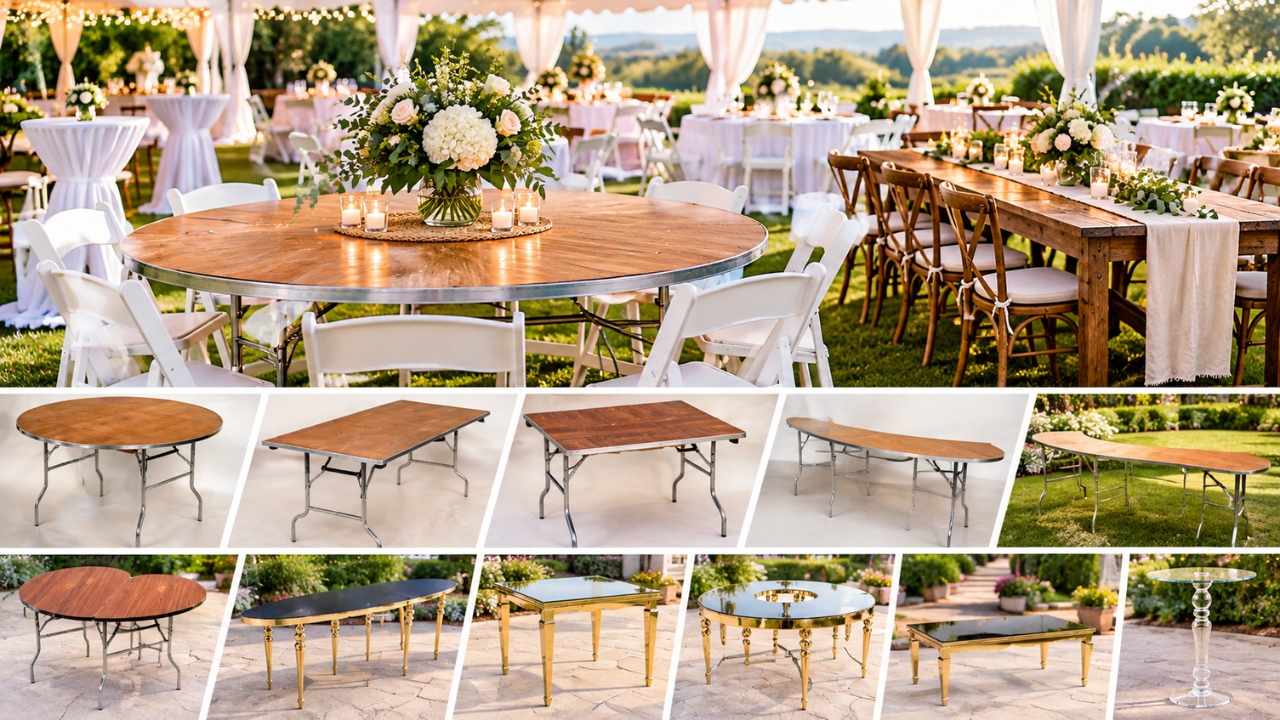
Renting tables for an event comes down to three decisions: shape, size, and how many you actually need once every surface — not just guest seats — is accounted for. Table rentals typically fall into a handful of shapes: round, rectangular (banquet), square, and a few specialty styles like serpentine and half-moon, each suited to a different guest count, room layout, and level of formality. Get those decisions right and the rest of the planning, from linens to floor layout, follows naturally.
This guide walks through each table type, how many people actually fit at each size, the tables most people forget to order, and the setup details — surface, spacing, weather — that are easy to overlook until the day of the event.
Table Shapes and What Each One Is Best For
Round Tables
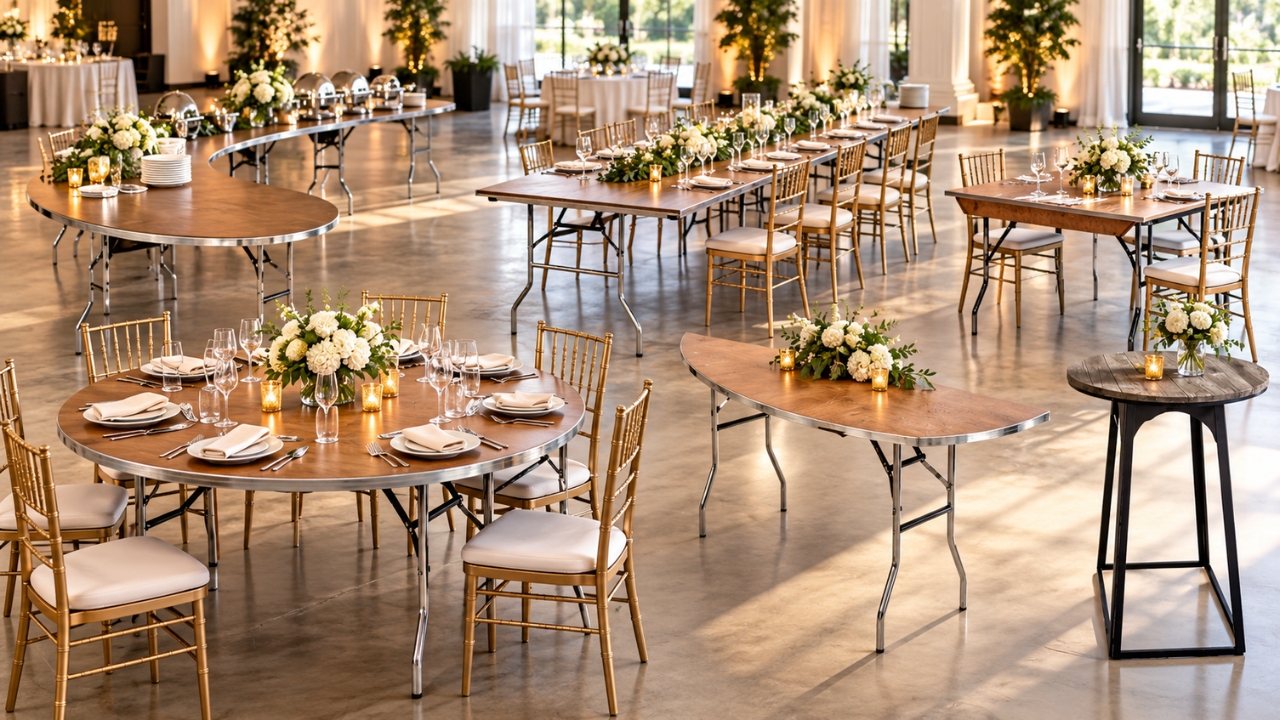
Round tables are the standard choice for seated dinners because every guest can see and talk to everyone else at the table — there’s no head or foot to the conversation. They’re common at weddings, galas, and any plated or family-style meal where mingling matters. Round tables typically run from a 30-inch table sized for two to four people up to an 84-inch table that seats a dozen or more, so the shape scales from an intimate sweetheart table to a large guest table without changing the look of the room.
Rectangular (Banquet) Tables
Banquet tables — sometimes just called rectangular tables — are the workhorse of buffets, corporate events, and any layout where floor space is tight. Lined up end to end, they seat more guests per linear foot than an equivalent number of round tables, which is why caterers favor them for buffet lines and why corporate and community events often use them for long guest rows. Banquet tables typically come in 4-, 6-, and 8-foot lengths across a few different widths, so a head table, a buffet run, and guest seating can all come from the same category.
Square Tables
Square tables split the difference: they photograph cleanly, suit smaller parties of four, and can be pushed together in blocks to seat a larger group without losing the clean-edged look. Square tables typically range from a 30-by-30-inch table for two to four guests up to a 60-by-60-inch table that seats up to a dozen, including hi-top versions for standing or cocktail-style seating.
Serpentine and Half-Moon Tables
These curved specialty tables aren’t built for guest seating — they’re built for display. A serpentine table rental curves in a gentle S-shape, and a half-moon table rental is exactly what it sounds like: a rounded edge on one side, straight on the other. Both are made to combine with straight banquet tables to build a flowing buffet line, a dessert table, or a curved bar setup — worth knowing before you order, since these work best paired with straight tables rather than seating guests at them directly.
Cocktail, Bar-Height, and Specialty Tables
For a standing reception or cocktail hour, high-top round and square tables (30- and 36-inch) give guests a place to set a drink without adding chairs to the floor plan. Beyond standard dining and cocktail sizes, many rental inventories also include designer and accent tables — glass-top, marble-finish, and industrial-style cocktail tables, antique-style farm tables, and even wine barrel-style coffee tables — that suit a lounge or cocktail-hour setting better than a standard dining table would. These specialty pieces are usually chosen deliberately for the one or two spots guests will actually notice, rather than used to furnish an entire room.
How Many Guests Fit at Each Table Size
This is the question most people actually have when they start looking at tables for events, so here’s the direct answer, size by size.
For round tables: a 30-inch round seats 2 to 4, a 36-inch round seats 4 to 5, a 42-inch round seats 5 to 7, a 48-inch round seats 6 to 8, a 60-inch round — the most common size for a seated dinner — seats 8 to 10, a 72-inch round seats 10 to 12, and an 84-inch round seats 12 to 14.
For square tables: 30-by-30 and 36-by-36-inch tables both seat 2 to 4 guests, a 48-by-48-inch table seats 6 to 8, and a 60-by-60-inch table seats 8 to 12.
For banquet (rectangular) tables, capacity depends on both length and width: the narrower 4- and 6-foot tables are typically used for buffets, gift displays, or head tables rather than guest seating, while the wider versions seat comfortably — a 4-foot table seats 4 to 6, a 6-foot table seats 6 to 8, and an 8-foot table seats 8 to 10, with a wider 8-foot, 48-inch version seating up to 12.
These numbers assume a standard place setting with room for a plate, glassware, and a chair on each side. For a buffet-style event where guests aren’t seated for a full course meal, you can generally push toward the higher end of each range; for a formal, multi-course dinner, plan toward the lower end so elbows and centerpieces have room to breathe.
Round or Rectangular: Which Is Right for Your Event
If you’re choosing between shapes and don’t have a venue requirement steering the decision, it usually comes down to two things: how you want guests to interact, and how much floor space you’re working with.
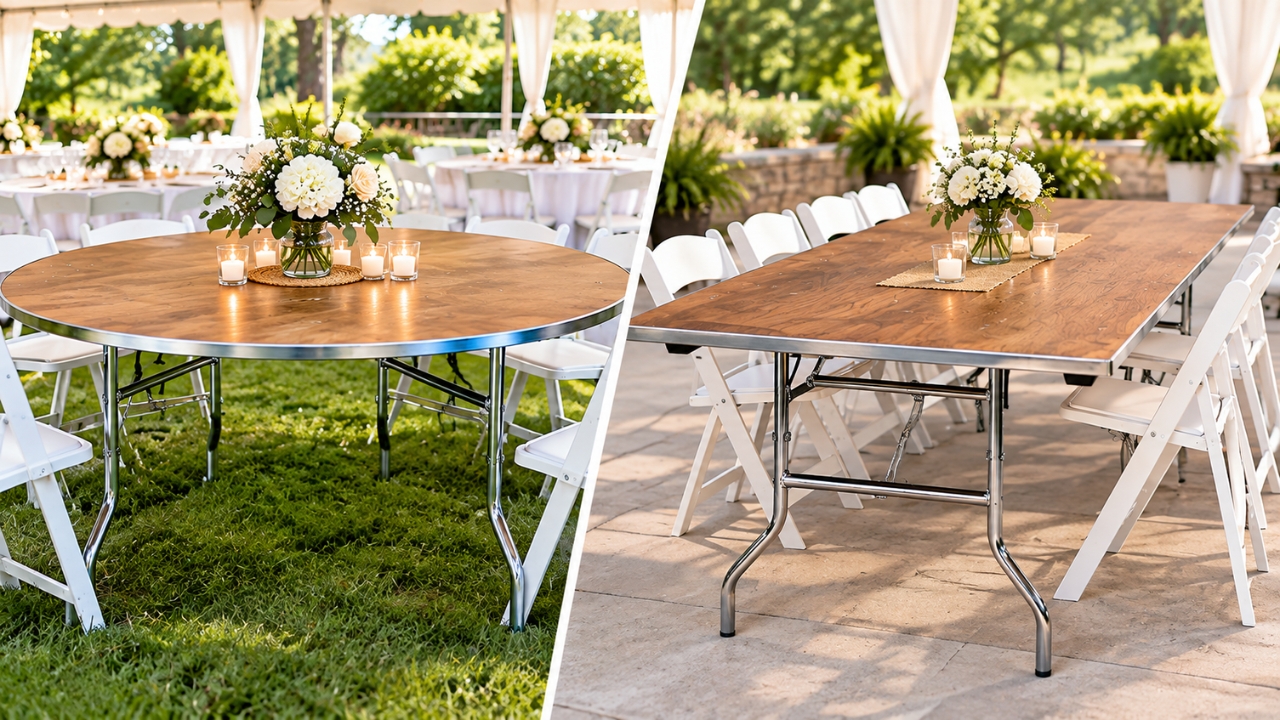
Round tables tend to work best for a wedding reception or any event centered on conversation, since everyone at the table can see and hear each other, and they give a room a softer, more traditional look. Rectangular tables read as more modern and are the practical choice when floor space is limited or the guest count is high — rows of banquet tables seat more people in less square footage than the same number of guests spread across round tables, which is part of why caterers and corporate event planners default to them for buffet-style meals. Rectangular tables also make family-style serving easier, since dishes can be passed straight down the line rather than around a circle.
There’s no rule against mixing shapes. A common layout uses round tables for guest seating and a rectangular table for the head table, sweetheart table, or gift and cake display, so you’re not locked into one shape across the whole event.
The Tables Most People Forget to Order
Guest seating is the part of the order everyone plans for. It’s also usually the smaller part of the list once you walk through the event from arrival to departure. Most events need a welcome or sign-in table, one or more tables for a buffet or food stations, a landing spot behind the bar for glasses and mixers, a table for the cake or dessert display, a spot for gifts and cards, and often a table for the DJ or band. If your event includes a stage setup and stage rental, you may also need dedicated tables nearby for sound equipment, performers’ items, or event staff needs. If you’re renting linens too, each of these working tables needs one sized to fit, the same as a guest table does.
It’s worth asking your caterer directly whether they need any additional prep tables out of sight of guests — many do, and it isn’t always volunteered until delivery day. Building this list before you finalize your guest-table count, rather than after, is the easiest way to avoid discovering a gap on the morning of the event.
Matching Tables to Your Event Type
Weddings and formal receptions generally call for round tables for guest seating, at least one rectangular or serpentine table for cake, gifts, or a guest book, and cocktail-height tables if there’s a separate cocktail hour before the reception. Package deals that bundle tables with chairs and other reception essentials are common for weddings and can simplify ordering compared with booking each piece separately.
Corporate events and conferences tend to lean on rectangular tables — for registration, buffet service, breakout seating, or a head table — because they pack more seating into a fixed room and set up quickly in rows.
Backyard parties, showers, and casual gatherings usually work fine with a mix of round tables for seating and a couple of rectangular tables for food and drinks, sized to the guest count rather than to any particular formality. Since backyard events are usually held on grass, it’s worth reading the surface guidance below before finalizing your order.
Whichever tables you choose, chair rentals are typically sized to pair with each table style, so it’s worth booking seating and tables together rather than mixing sources — consistent sizing and one coordinated delivery helps avoid mismatched chair heights or spacing on the day of the event.
Tablecloths and Linens: Getting the Right Fit
Once you know your table sizes, tablecloth sizing follows a simple rule: measure the table, decide on a drop length, and add that drop to each side of the table’s dimensions. “Drop” is the length of fabric that hangs down from the tabletop — a short or “lap” drop of around 6 to 12 inches is common for casual events, while a full, floor-length drop (roughly 29 to 30 inches on a standard 30-inch-high table) is the standard for weddings and formal dinners.
In practice, that means a 60-inch round table typically takes a 120-inch round tablecloth for a floor-length drop, and an 8-foot banquet table typically takes a linen sized well beyond the tabletop to reach the floor on all sides — always confirm the exact linen size against the specific table you’re renting, since drop preferences vary by event. Renting linens from the same supplier as your tables is often the simplest way to get a correct fit, since a rental company’s linen sizing is typically matched to its own table inventory.
Setting Up: Space, Surface, and Weather
A few practical details matter as much as the tables themselves. Beyond the seats, plan room for chairs to push back and for servers or guests to walk between tables — a comfortable layout leaves at least a few feet of walkway between table edges, more if there’s a buffet line or dance floor guests need to reach.
Tables set up on grass need level, firm ground; on soft or uneven turf, legs can sink unevenly, which is one of the reasons tables for outdoor events are so often paired with a tent and, where the ground calls for it, a flooring or subfloor rental. Sizing the tent to the table layout and guest count is worth doing before finalizing either order, since the two decisions affect each other directly.
Weather matters even under cover. For any outdoor event, a tent isn’t just about shade — a table exposed to wind or a sudden shower can mean a ruined linen or a scramble to move place settings indoors. If there’s any chance of rain, planning for tables to go under some form of cover is worth the extra step.
Common Table Rental Mistakes
- Counting only guest seats and forgetting the cake, gift, guest-book, or buffet table until setup day
- Ordering the exact headcount in seats with no buffer for a last-minute plus-one or a vendor who needs a spot
- Choosing a linen size at the last minute and ending up with a drop that pools on the floor or leaves the table legs exposed
- Setting rectangular or round tables on soft or sloped grass without checking the ground first, which leaves place settings unlevel
- Mixing table heights — standard dining height and cocktail height — without planning which guests sit and which stand, which can leave a cocktail-height table with no chairs nearby
Conclusion
Choosing table rentals for an event comes down to matching shape and size to your guest count and the feel you’re going for — round for conversation-friendly seating, rectangular for buffets and tighter floor plans, and a specialty piece or two for the surfaces guests don’t sit at. B&B Tent and Party Rentals carries all of these — round, banquet, square, serpentine, half-moon, cocktail, and designer tables — sized and ready to pair with chairs, linens, and a tent if your event is heading outdoors. Request a quote and B&B’s team can help match the table mix to your guest count and venue.
Frequently Asked Questions
A 60-inch round table seats 8 to 10 guests comfortably with a standard place setting. Plan for 8 if it’s a formal, multi-course meal, and you can push to 10 for a more casual, buffet-style event.
Round tables are the traditional choice for wedding guest seating because they make conversation easier around the whole table. Rectangular tables are common for the head table, a gift or cake display, or for weddings going for a more modern look — many receptions mix both.
It depends on the table’s exact length and width and how much drop you want. As a starting point, measure the table and add your desired drop length — roughly 6 to 12 inches for a casual look, 29 to 30 inches for a full floor-length drop — to each side, then confirm the closest available linen size when you order.
Almost always, yes. Most events need at least one extra table for the cake, gifts, or a guest book, and often another for a buffet or drink station. It’s worth adding these to your count before finalizing an order.
Yes, but the ground needs to be reasonably level and firm. On soft or uneven grass, table legs can sink or wobble unevenly, which is why outdoor events on grass are frequently paired with a tent and, when needed, flooring underneath the tables.
You May Also Like
The Ultimate Guide to Choosing the Right Event Tent
The right event tent depends on four things: how many guests....
Read More »Which Table Shape Works Best for Different Events?
Choosing the right table shape is an important part of planning....
Read More »Event Table Rentals: Everything You Need to Know
Renting tables for an event comes down to three decisions: shape,....
Read More »How to Choose the Right Table Size for Your Venue
The right table size for your venue comes down to matching....
Read More »Top Chair Styles for Weddings, Parties & Corporate Events
From classic folding chairs to statement throne chairs, twelve styles account....
Read More »How to Choose the Right Chair Rentals for Your Event
Most people pick event chairs the way they pick a font....
Read More »Folding Chairs vs Chiavari Chairs: Which Should You Rent?
Seating is one of the first decisions on any event checklist,....
Read More »