

The Ultimate Guide to Choosing the Right Event Tent
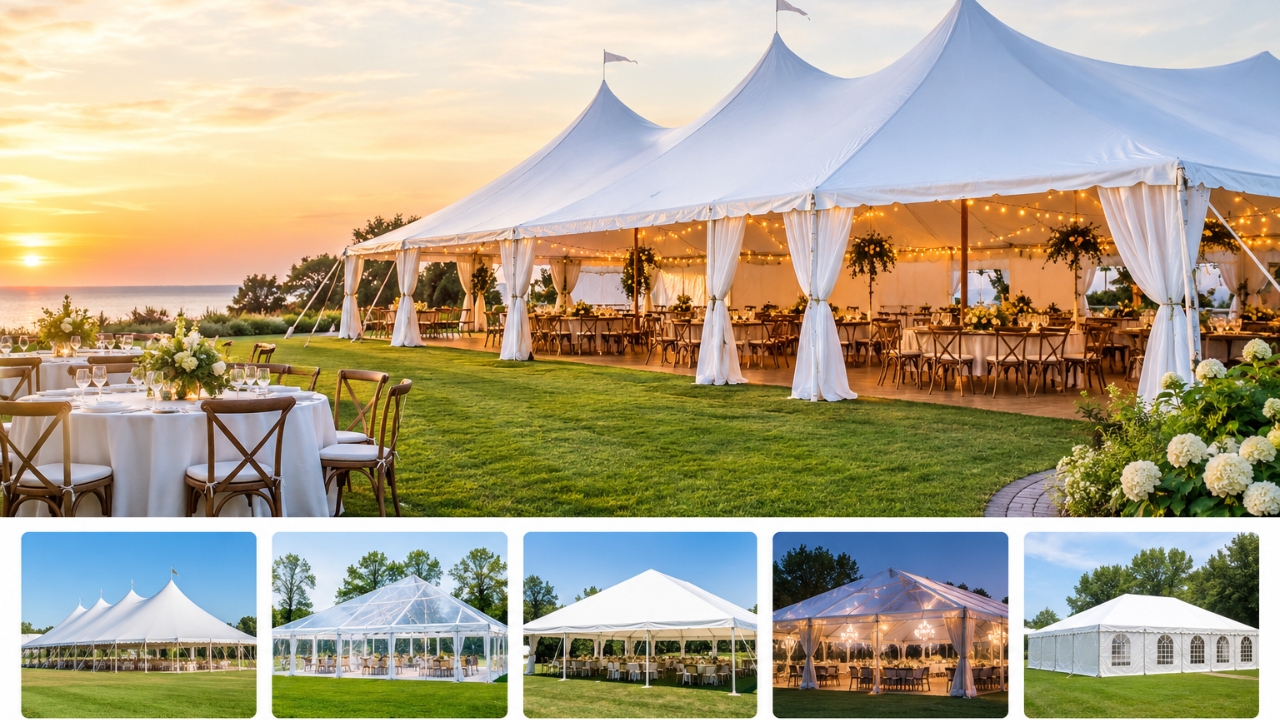
The right event tent depends on four things: how many guests you expect, how you will lay out the space, what the tent will stand on, and how formal the event feels. Settle those in that order and the choice between tent types mostly makes itself.
Most people choose the other way around. They scroll through photos, fall for a look, and only check the practical details once a quote arrives. That order costs time and sometimes money. This guide flips it. It explains what a tent rental includes, shows how to size and shape the space, compares the main styles of event tent rentals, and ends with costs, common mistakes, and a checklist you can take into your first call.
Tent Rental Basics: What to Know Before You Book
Tent rental means hiring a temporary covered space for your event, with the rental company delivering, installing, and removing it. You choose the size and style. The crew handles the heavy work.
The tent is only the starting point. Most events also need sidewalls, lighting, flooring, and sometimes heating, cooling, or a ceiling liner. On our tent pages, the listed tent does not include sidewalls or lighting, though both can be added for an additional fee. That detail matters, because a tent that looks affordable on its own can cost more once the pieces you need are on the quote. Our tent accessories page shows what you can add.
People rent tents for weddings, graduations, birthday parties, fundraisers, corporate events, and backyard dinners. The goal stays the same each time: shade, shelter from rain, and a defined space for tables, a dance floor, a buffet, or a bar.
Why Shape and Size Matter Before You Rent
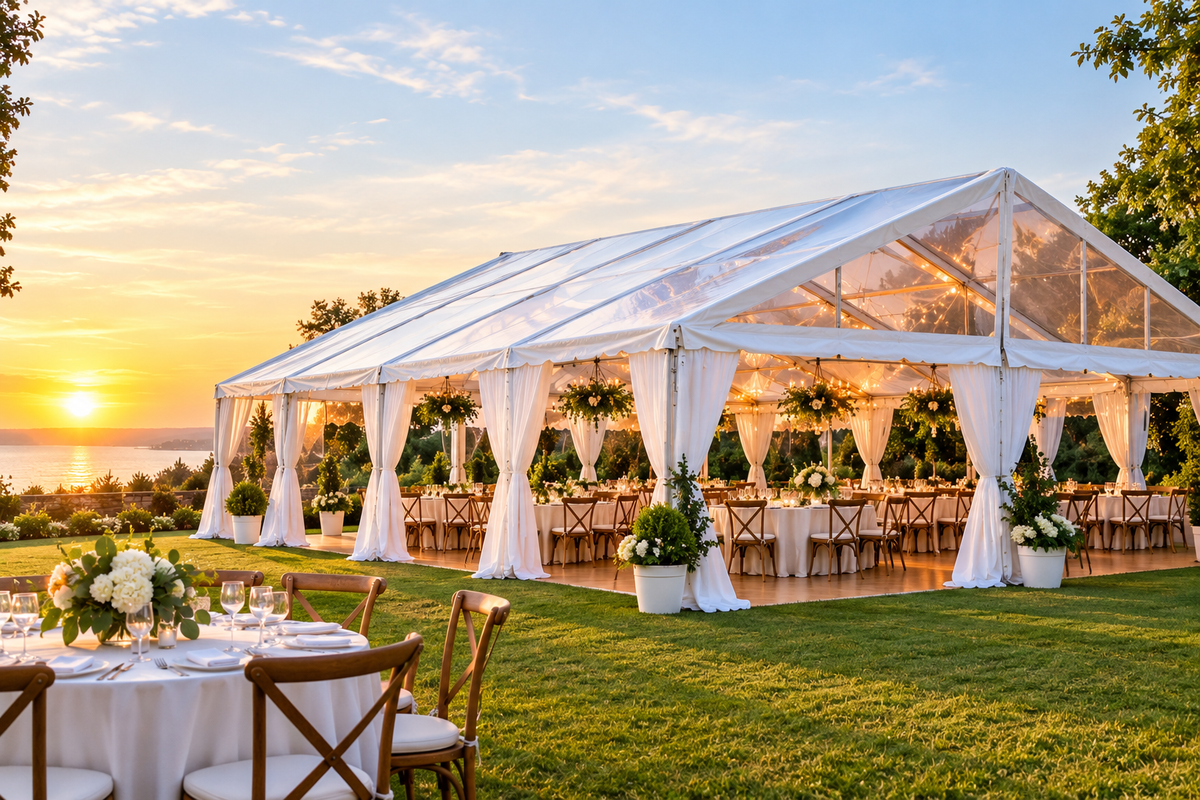
Guest count tells you how many people are coming. It does not tell you how big the tent should be. A tent is measured in square feet, and how many guests it holds depends on how those guests will sit, stand, and move.
For a seated dinner, our rule of thumb is about 10 square feet per person. Our tent listings show a similar range: a 20×30 tent has 600 square feet and seats 48 to 60, which works out to roughly 10 to 12 square feet per seat. That math covers tables and chairs only. The dance floor, buffet, bar, DJ, cake table, and stage all need space on top of it. Our tent calculator runs the numbers for your seating style, so use it before you settle on a size.
Getting the size wrong hurts in both directions. A tent that is too small leaves guests crowded and makes it hard for servers to move between tables. A tent that is too big costs more and can leave your event feeling empty.
Shape decides how the room works, and your right table sizes decide how many tables fit inside it. A square tent, like a 30×30, suits a grid of round tables around a central dance floor. A long rectangle, like a 20×40 or 30×60, suits long banquet tables, a stage at one end, or a ceremony with a center aisle. A narrow tent, like a 10×30, works for a buffet line, a bar, or a catering setup.
Measure your space before you pick a size, because the ground you need is larger than the tent itself. A century pole tent, for example, needs an extra 10 feet on every side for stakes.
Understanding the Different Types of Event Tents
We rent five main tent styles. They differ in three ways: what holds the tent up, what the roof looks like, and what the tent needs from your site. Once you understand those three things, the rest of the choice gets much easier. Here is how each style works and when it fits.
1. Frame Tents
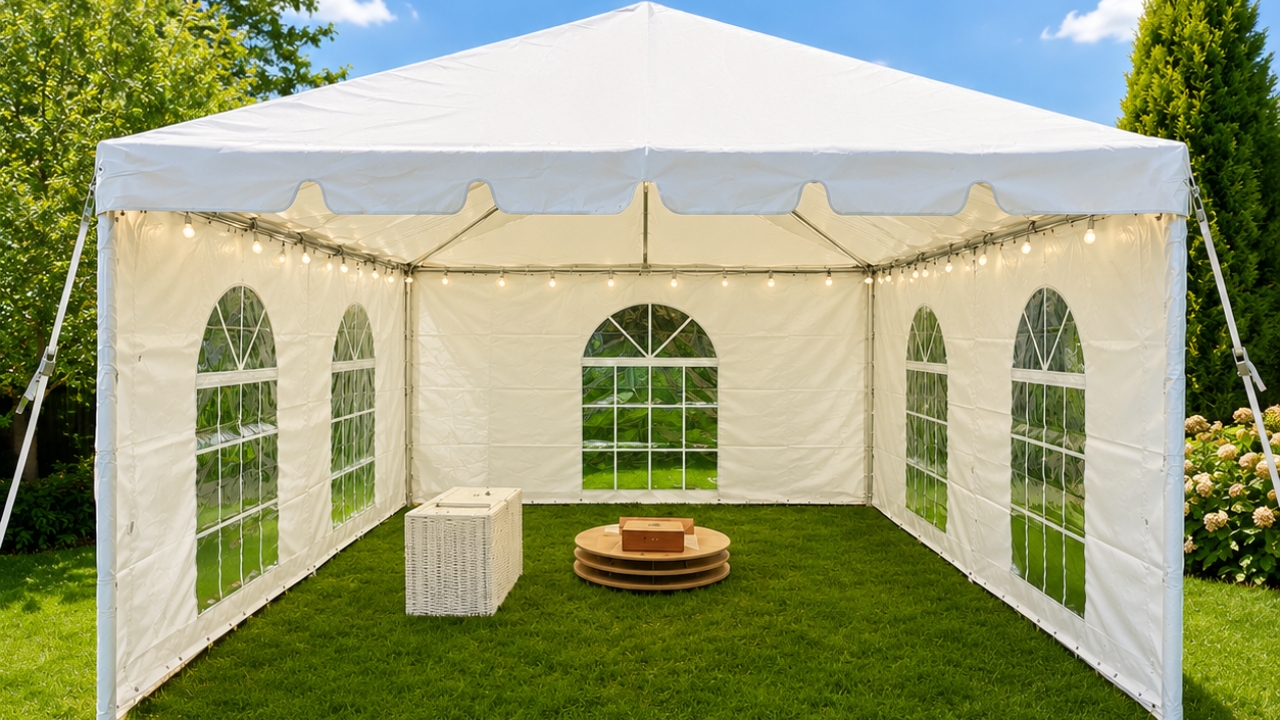
A frame tent stands on a metal frame, with the roof fabric stretched over the top. The weight sits on the legs around the edge, so nothing runs through the middle of the space. That open floor is why frame tents suit so many different events.
Best for: Events on any surface, including patios, driveways, decks, and lawns, and large guest counts that need a wide-open floor.
Why it works: Because the inside stays open, you can place tables, a dance floor, and a stage without working around poles. Our frame tents run from small 10×10 sizes up to 50×120, and we consider them our most versatile option.
Keep in mind: When we cannot stake into the ground, such as on concrete, pavers, or a deck, the tent needs weights for safety and to meet fire code. That adds to the cost.
2. Century Pole Tents
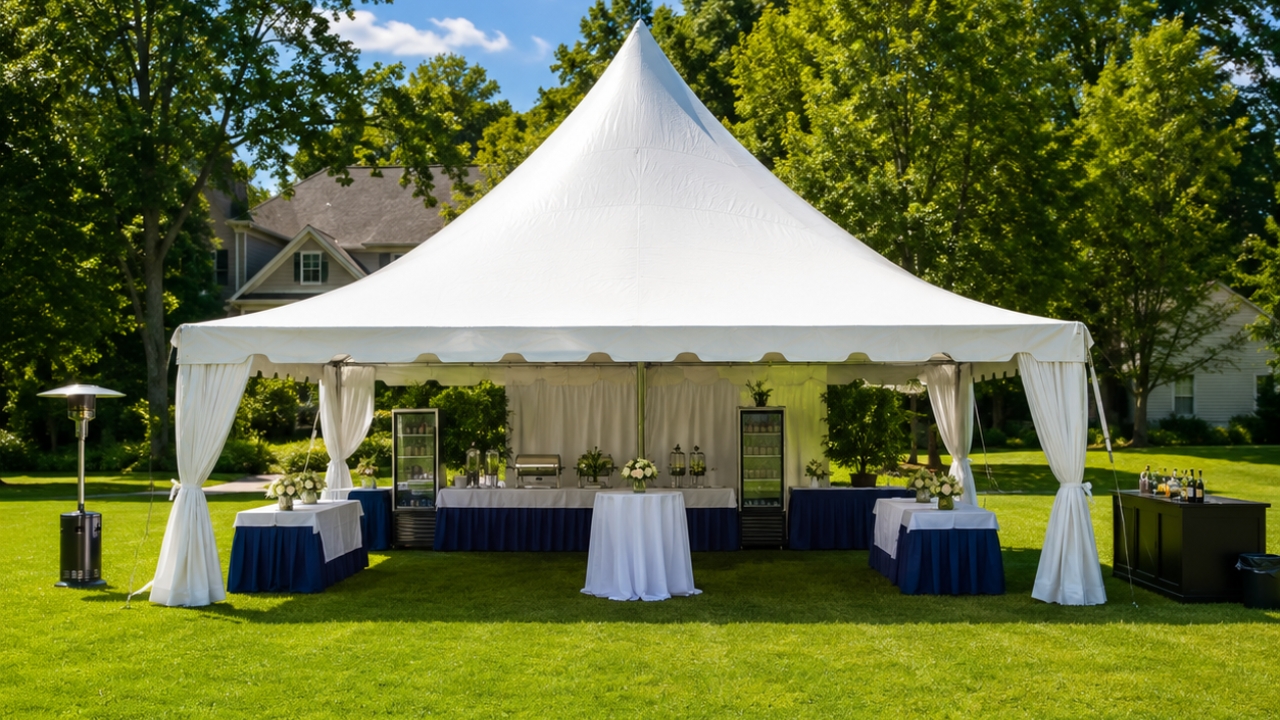
A century pole tent is held up by poles inside the tent, with stakes driven into the ground around the outside to anchor it. The poles lift the roof into a high peak, which gives the tent its classic party shape.
Best for: Lawn events on grass, from backyard parties to large receptions.
Why it works: Poles and stakes hold the tent in place, and it is often a more economical choice, depending on the size you need. Our century pole tents start at 20×20 and go up to 80×100 and beyond.
Keep in mind: This style can only go on grass. The stakes extend out from the sides, so you need an extra 10 feet around the tent. Poles also stand inside the tent, so plan your tables around them.
3. Sailcloth-Style Tents
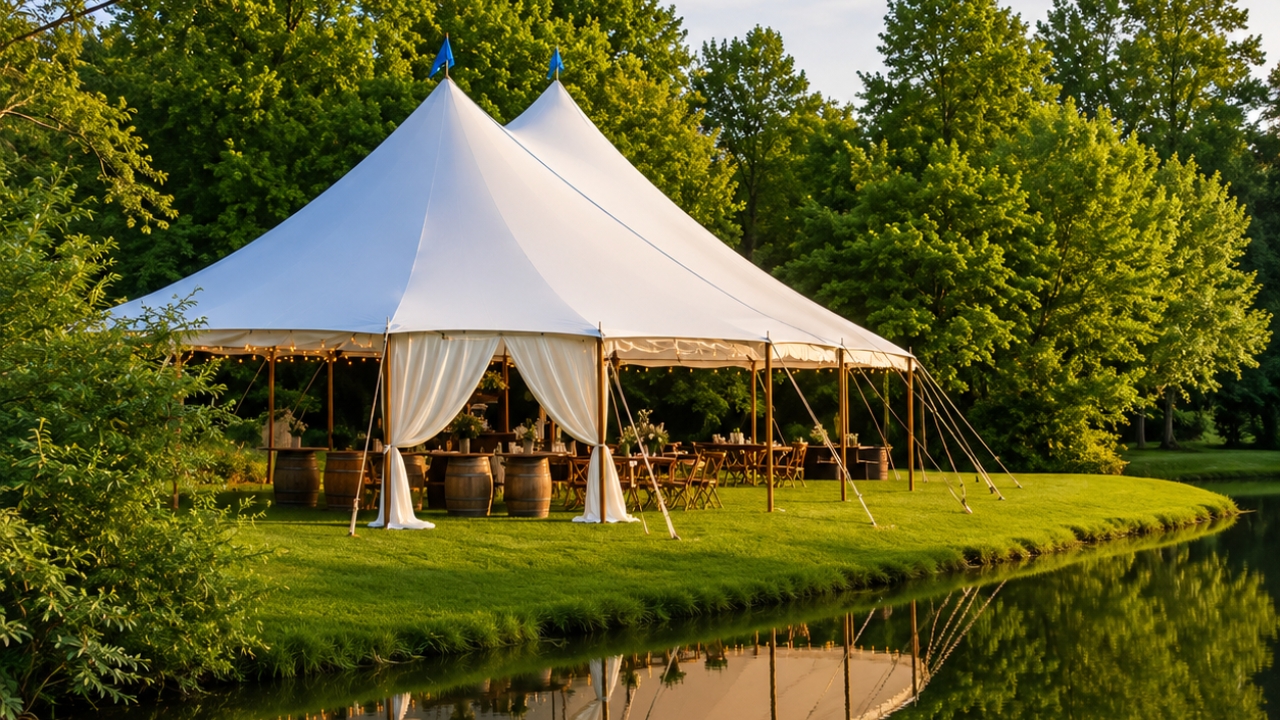
A sailcloth-style tent uses soft, stretched fabric that rises into swooping peaks. Light passes through the fabric and fills the inside with a soft, airy glow, so the tent looks good with very little added decor.
Best for: Weddings and outdoor events where the tent is part of the look.
Why it works: The swooping peaks and soft glow give the space a refined feel on their own. See the full range of sailcloth-style tents.
Keep in mind: This range comes in six sizes, so check that one fits your headcount and your space before you commit to the look.
4. Clear Top Tents
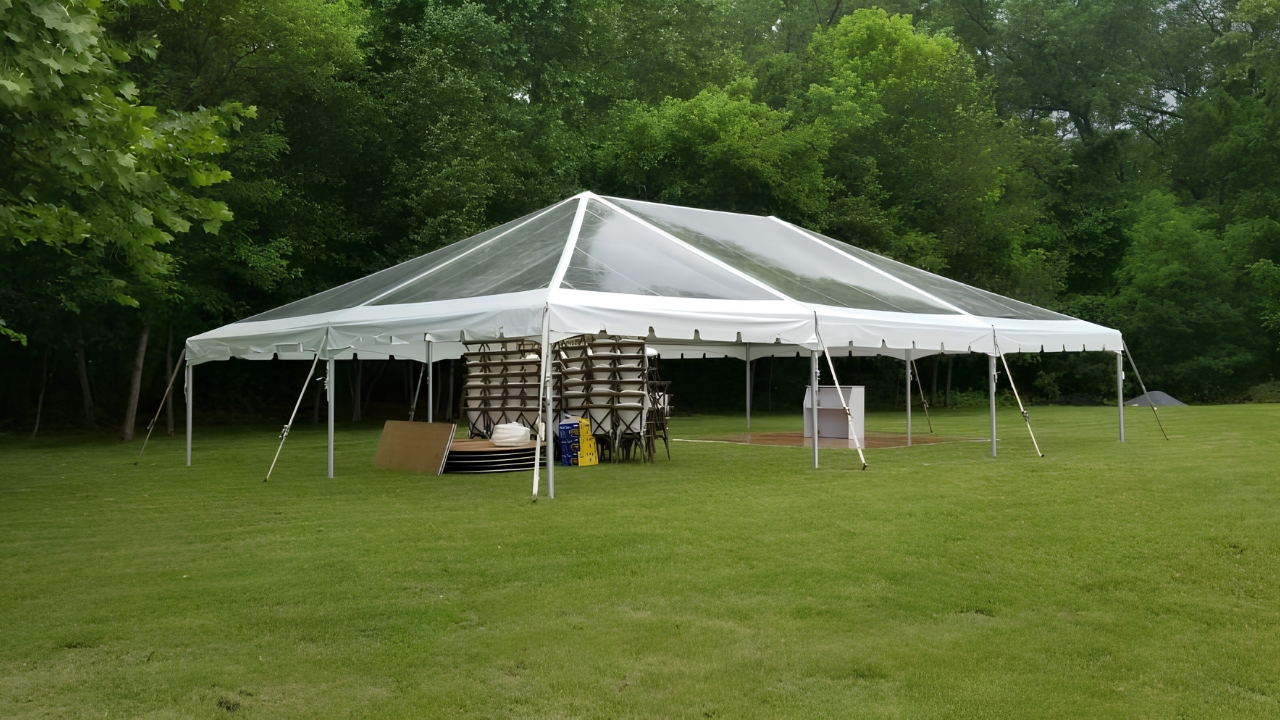
A clear top tent replaces the usual white roof with clear vinyl. Guests stay dry under cover while the roof lets in daylight by day and shows the sky at night.
Best for: Weddings, galas, corporate events, and evening parties where guests will enjoy daylight or the night sky.
Why it works: The clear roof lets in natural light by day and gives a view of the sky at night, so the tent needs less decoration to feel special. Browse our clear top tents to compare sizes.
Keep in mind: We cannot install a clear top tent if temperatures are expected to dip below 35°F, because the clear vinyl turns brittle and can crack. For cooler dates, a white-top frame tent is the safer choice.
5. Marquee Tents
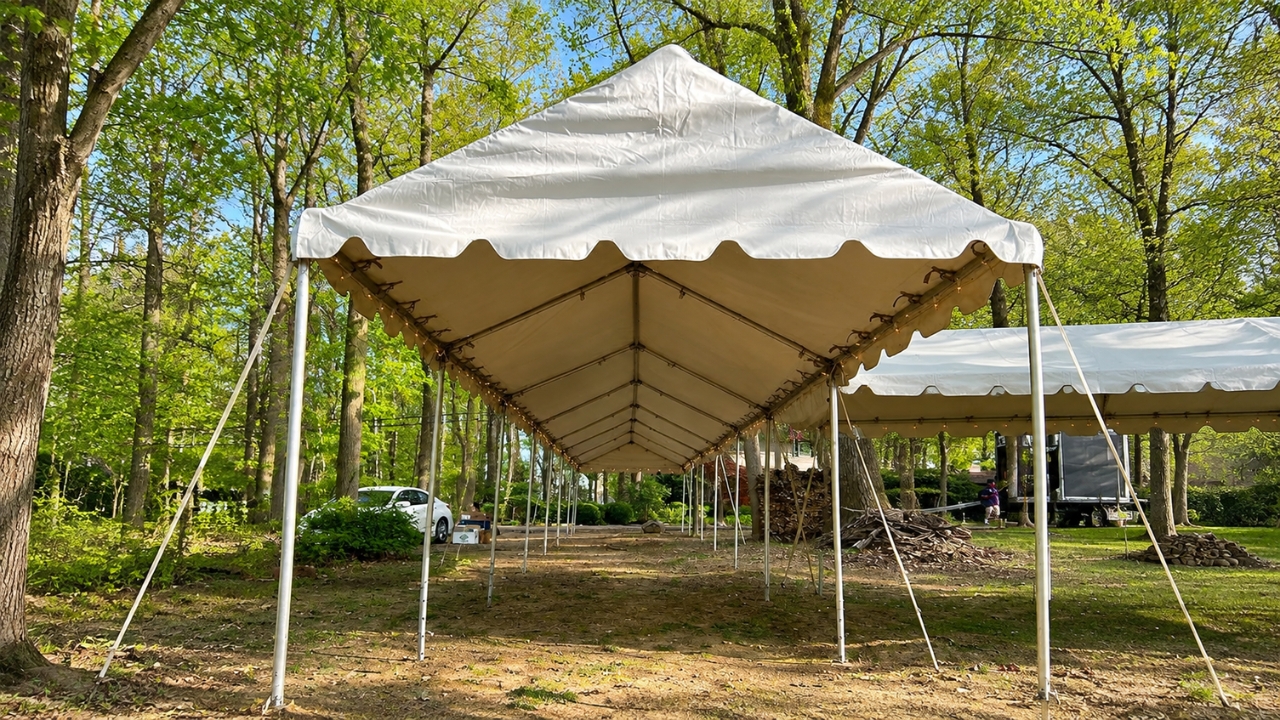
Marquee tents are built to give you the showy look of a high-pitched pole tent with the easier installation of a frame tent. In our lineup, they come as long, narrow runs that start at 10×150.
Best for: Covered walkways, entrances, and long feature runs where you want visual impact.
Why it works: You get the dramatic roofline of a pole tent without needing poles down the middle. Our marquee tents are worth a look if you want to frame an entrance or link two spaces.
Keep in mind: At 10 feet wide, these work as a corridor, not a dining room. Pair one with a larger tent when you need seating.
A quick way to remember the differences: frame tents win on flexibility, century pole tents on grass and budget, sailcloth-style and clear top tents on looks, and marquees on entrances. If you are still undecided, narrow it down in this order. Start with the surface, because grass opens up every style while a hard surface points to a frame tent. Then check the forecast, then your guest count, and choose the look last.
Consider the Type and Style of Your Event
Your tent should follow what happens underneath it. The same guest count needs a different tent for a wedding than for a graduation barbecue.
- A wedding usually asks for the most of a tent. Guests may sit for a ceremony, eat dinner, and dance in the same space, so you need room for round tables, a dance floor, a bar, and often a head table or stage. Sailcloth-style and clear top tents suit the look many couples want, while a frame tent gives you the most freedom with layout. Our wedding party packages group the rentals most receptions need, which makes it easier to see how much floor the full setup takes.
- Seated dinners and family gatherings use the most space per person. Plan for the full amount of floor, and remember that large round tables take more room than their guest count suggests. Our dinner party packages are a good starting point for picking the furniture that goes under the tent.
- Cocktail parties and standing receptions need less floor per guest than a sit-down meal, so a smaller tent can work. Leave room around bars, high-top tables, and food stations, because that is where people gather.
- Casual events like birthdays, graduations, and backyard get-togethers mostly need shade and rain cover. A smaller frame or century pole tent with simple seating usually does the job.
- For corporate events and fundraisers, think about the stage, screen, registration table, and any auction tables, and choose a style with an open interior so nothing blocks the sightlines.
Season matters just as much. In cold weather you will want sidewalls and a way to keep guests warm, and a clear top may not be an option. Our heater rentals pair well with a closed-in tent.
In hot weather, shade alone is not enough. Airflow keeps guests comfortable through a long dinner, and our cooling rentals are worth adding for summer dates.
For events that run into the evening, plan the lighting early. Our tent lighting is not included in the tent price, so it needs to be on your quote.
Understand Event Tent Rental Costs
Tent cost depends mostly on size, then on style, surface, and add-ons. Start with size, because it sets the base price.
- Century pole tents: A 20×20 (400 square feet, seats 32 to 40) starts at $395. A 40×60 (2,400 square feet, seats 192 to 240) starts at $2,400. This is the lowest price at each size, and it only works on grass.
- Frame tents: A 20×20 starts at $549 and a 40×60 starts at $3,000, with the same seating as above. The smallest, a 10×10 (100 square feet, seats 8 to 10), starts at $300. Frame tents work on any surface.
- Clear top tents: A 20×20 starts at $995 and a 40×60 starts at $4,200, with the same seating. A clear top costs more than a frame tent of the same size.
- Sailcloth-style tents: These come in six sizes. A 45×44 (seats 128 to 140) starts at $2,475, and a 45×144 (seats 448 to 560) starts at $8,100.
- Marquee tents: These are long, narrow runs, 10 feet wide. The shortest, a 10×150 (1,500 square feet), starts at $3,150.
These are starting prices for the tent only, and they were current when we wrote this guide. Check the tent page for today’s price. Here is what moves the total.
Size. Bigger tents cost more, but not in a straight line. A 20×40 century pole tent seats twice as many guests as a 20×20 for about 1.5 times the price. If you are between two sizes, going up one is often the better deal.
Style. Century pole tents cost less than frame tents at every size we offer in both styles, but they only work on grass. Clear top tents cost more than frame tents. A 40×40 clear top starts at $2,800, against $2,000 for a frame tent.
Surface. A tent staked into grass needs no weights. On concrete, pavers, or a deck, we add weights for safety and fire code at an additional cost.
Add-ons. Sidewalls and lighting are not included in the tent price. Heating, cooling, and liners are separate too, and so is tent flooring.
Furniture. Tables, chairs, and linens are separate rentals. Our table rentals show what each shape seats.
When you compare quotes, make sure each one covers the same tent size and the same add-ons. The lowest number is not always the lowest total.
Common Mistakes to Avoid When Choosing an Event Tent
Most tent problems come from a few planning errors. Here are the ones we see most often.
Sizing by guest count alone. A tent that fits 100 people in rows will not fit 100 people at round tables with a dance floor. Size the tent for your layout, not just your headcount.
Forgetting what else goes inside. Buffets, bars, a DJ, a stage, and a cake table all take floor space. Add them to your square footage before you pick a size. Remember to account for tables and chair rental requirements when planning your seating arrangement.
Ignoring the ground. Century pole tents need grass. Frame tents handle hard surfaces, but they need weights when we cannot stake, and that changes the cost. Check your surface first, and read the surface rules in our FAQ.
Measuring only the tent. The footprint is bigger than the tent. Stakes and crew access need room, and a century pole tent needs an extra 10 feet on every side.
Booking a clear top without checking the forecast. We cannot install one if temperatures are expected to dip below 35°F. Keep a white-top frame tent in mind as a backup.
Assuming sidewalls and lighting are included. They are not part of the listed tent price. Ask for the full list of what is on your quote before you accept it.
Choosing on looks before layout. Photos sell a style, but your layout decides whether it works. Settle the layout and the surface first, then pick the look.
Event Tent Selection Checklist
Work through these steps before you request a quote. The order matters, because each step narrows the next one.
Start with your guests. Confirm your guest count and how many will be seated at the same time, then choose your seating style: round tables, banquet tables, or standing. List everything else that needs to go under the tent, including the dance floor, bar, buffet, stage, DJ, and cake table. Add up the square footage and test it in the tent calculator, then pick the shape that fits your layout, whether that is square, rectangle, or long and narrow.
Next, look at your site. Measure the space and leave extra room around the tent for stakes and crew access. Check the surface, whether it is grass, concrete, pavers, or a deck, because that decides which tent styles are open to you. Then choose a style that suits the surface and the look you want: frame, century pole, sailcloth-style, clear top, or marquee.
Then check the season and the forecast. Plan for heat, cooling, or sidewalls as needed, and list your add-ons, including sidewalls, lighting, flooring, a ceiling liner, heating, and cooling. Plan your tables, linens, and chair rentals to match the tent size, so your furniture fits the space you chose.
Frequently Asked Questions
It depends on how your guests will be seated, not just how many there are. For a seated dinner, plan on about 10 square feet per person, and our listings show roughly 10 to 12 square feet per seat. For example, a 20×30 tent has 600 square feet and seats 48 to 60. Then add room for the dance floor, buffet, bar, and stage, and use the tent calculator to check your total before you book.
Yes, with a frame tent. A frame tent can go on any surface. When we cannot stake into the surface, we add weights to keep the tent safe and to follow fire code. Weights add to your cost, so mention your surface when you ask for a quote. Century pole tents can only go on grass.
A frame tent stands on a metal frame, so the inside stays open and it can go on any surface. A century pole tent is held up by poles inside the tent and anchored with stakes, so it can only go on grass and needs an extra 10 feet around it for those stakes. Century pole tents are often the more economical choice, while frame tents are the more flexible one.
There is no single best tent, because it depends on your look, your surface, and your date. Sailcloth-style and clear top tents give the most visual impact, while a frame tent gives you the most freedom with layout and surface. A clear top needs mild weather, so check your date first. Whichever style you like, size the tent for your seated dinner, dance floor, and bar before you commit.
Not below 35°F. We cannot install one if temperatures are expected to dip below that, because the clear vinyl becomes brittle and can crack. For cooler dates, a white-top frame tent is the better choice. It keeps the elegant look without the cold-weather risk, and you can add heat to keep guests comfortable.
No. Neither is included in the listed tent price, but both can be added for an additional fee. Sidewalls help with wind, cool air, and privacy, and lighting matters for any event that runs into the evening. Ask for both on your quote so the total is clear from the start.
You May Also Like
The Ultimate Guide to Choosing the Right Event Tent
The right event tent depends on four things: how many guests....
Read More »Which Table Shape Works Best for Different Events?
Choosing the right table shape is an important part of planning....
Read More »Event Table Rentals: Everything You Need to Know
Renting tables for an event comes down to three decisions: shape,....
Read More »How to Choose the Right Table Size for Your Venue
The right table size for your venue comes down to matching....
Read More »Top Chair Styles for Weddings, Parties & Corporate Events
From classic folding chairs to statement throne chairs, twelve styles account....
Read More »How to Choose the Right Chair Rentals for Your Event
Most people pick event chairs the way they pick a font....
Read More »Folding Chairs vs Chiavari Chairs: Which Should You Rent?
Seating is one of the first decisions on any event checklist,....
Read More »